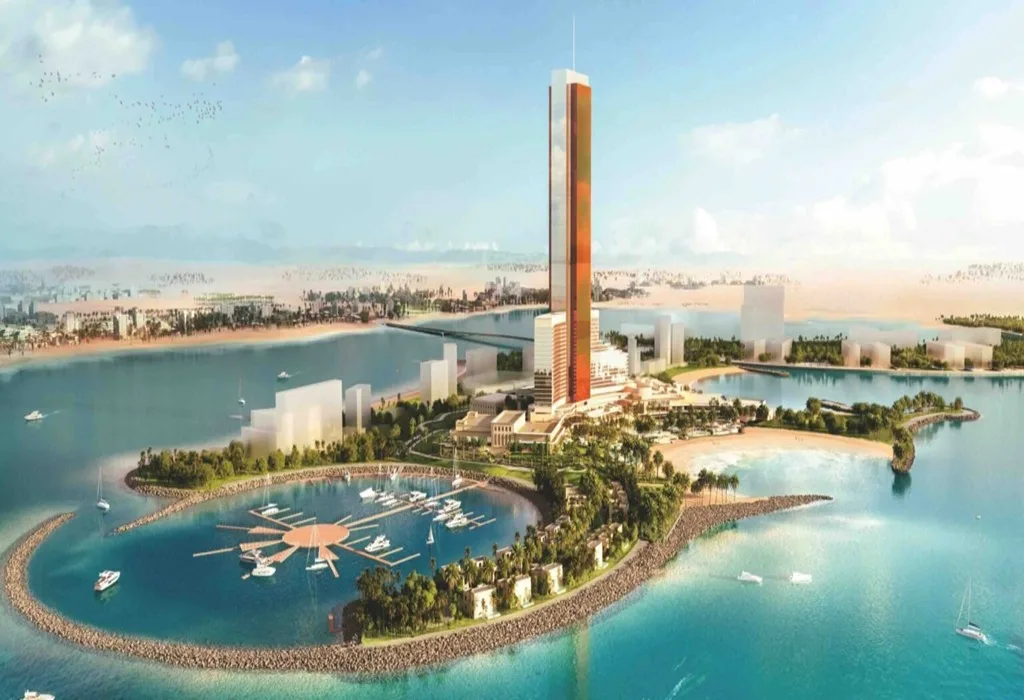
Ras Al Khaimah is moving into an important phase of its property market story.
The emirate already has a strong tourism base, growing residential development and rising investor interest. But the biggest catalyst is still ahead: Wynn Al Marjan Island, the integrated resort being developed on Al Marjan Island.
The resort is currently scheduled to open in September 2027. It will include 1,530 hotel rooms and suites, restaurants, entertainment venues, luxury retail, meeting facilities and the UAE’s first commercial gaming facility. The total investment is now estimated at about US$5.7 billion.
The important question for property investors is not simply what the casino will generate.
The bigger question is:
What happens to the surrounding real estate market when a major international resort becomes operational?
There are useful examples from markets where Wynn has already operated, particularly Las Vegas and Macau. They do not provide a direct forecast for RAK, but they help explain why an integrated resort can affect surrounding tourism, employment, hospitality and property demand.
The Wynn effect has already started in Al Marjan Island
The most interesting thing is that the story of this property will not begin in 2027.
It started with the announcement.
Wynn Al Marjan Island was announced in January 2022. Since then, land prices on Al Marjan Island have risen rapidly.
Wynn Resorts’ investor presentation shows average achieved land prices on Al Marjan Island rising from about US$73 per sq ft in 2021 to US$207 per sq ft by September 2025. The same presentation describes this as the “Wynn Effect” and links the increase to the announcement of the resort.
Residential values have also moved significantly.
According to third-party market data compiled by OBG, average off-plan apartment prices across Ras Al Khaimah increased from about AED 950 per sq ft in January 2022 to AED 2,990 per sq ft in 2025, while average off-plan villa prices increased from approximately AED 1,070 to AED 2,109 per sq ft.
This does not mean Wynn alone caused all of that growth. RAK has several other drivers, including tourism, new developers, branded residences, infrastructure and limited prime waterfront stock.
But the timing is important.
The Wynn announcement came before much of the recent development cycle.
Al Marjan Island is already outperforming much of RAK
The island has become one of the strongest residential markets in the emirate.
ValuStrat’s Q3 2025 data showed Al Marjan Island apartment capital values rising 16.8% year on year, the highest apartment growth among RAK locations tracked in that report. The broader RAK apartment market increased 15.5% over the same period.
This is important because Al Marjan Island is not starting from a weak base.
It has already attracted major branded residential and hospitality projects.
The next phase will be different because the Wynn resort moves from being a development story to an operating tourism asset.
That distinction matters.
A proposed resort creates expectations.
An operating resort creates:
- hotel employment
- visitor spending
- restaurants and retail demand
- entertainment activity
- corporate requirements
- hospitality jobs
- transport demand
- short-term accommodation demand
- demand for nearby residential property
Marjan itself says Wynn is expected to support infrastructure upgrades, premium real estate demand and additional hospitality and lifestyle development across the emirate.
Las Vegas and Macau Real Estate Performance
The Las Vegas and Macau examples should not be treated as direct property forecasts for Ras Al Khaimah.
Their economies, regulations, population structures and tourism markets are different.
However, they demonstrate an important principle:
Large integrated resorts can change the economic value of the locations around them.
Wynn Las Vegas opened in April 2005. Within its first full year, the resort reported an average hotel occupancy of 94.4%, compared with 89.7% for the wider Las Vegas market, while its average daily room rate was $287 versus $120 for Las Vegas overall. (SEC)
Macau provides an even more relevant example of the casino-tourism-property relationship.
Wynn Macau opened in September 2006. By the end of 2010, Macau’s hotel-room inventory had increased from 12,978 rooms in 2006 to 20,091 rooms, while the number of gaming tables increased from 2,760 to 4,791.
Contemporary property-market reporting at the time also linked the expansion of the gaming industry with expectations for stronger demand for high-quality residential property and accommodation for higher-income professionals. (South China Morning Post)
The lesson is not that Wynn automatically causes property prices to double.
The lesson is that a major integrated resort can create an economic ecosystem around itself.
That ecosystem can become more important than the casino itself.
RAK has one major advantage: the market is still relatively small
This is where the RAK story becomes interesting.
Dubai already has a huge property market, a large international workforce and hundreds of established communities.
RAK is considerably smaller.
That means a large tourism project can have a more visible impact on the local economy and property supply-demand balance.
Wynn Al Marjan Island is expected to create more than 7,000 direct jobs, according to Marjan.
Those workers will need housing.
Hotels will need staff.
Restaurants will need employees.
Retail businesses will need workers.
New companies may establish offices.
Visitors will need hotels and short-term accommodation.
And businesses supporting the resort will need commercial space.
This creates several layers of potential property demand rather than a single source of demand from investors.
RAK Central could become another important piece
The effect may also extend beyond Al Marjan Island.
RAK Central is being developed as a large mixed-use district with more than 4,000 apartments, four hotels, offices, retail and entertainment facilities.
Marjan has reported that all plots in the masterplan have been sold. The project is being developed in phases and is scheduled for completion by 2030. (The National)
This is significant because it shows that the investment cycle is spreading beyond the immediate Wynn site.
Al Marjan Island can act as the tourism anchor.
RAK Central can provide another commercial and residential node.
Other communities can benefit as the workforce, visitor economy and business activity expand.
That is how a single mega-project can gradually influence a wider property market.
The real opportunity may come before the opening
There is an important difference between buying because a casino opens and understanding the development cycle around it.
Property markets often react in stages.
Stage 1: Announcement
Investors buy into the future story.
This is largely what happened after Wynn was announced.
Stage 2: Construction
Infrastructure becomes visible.
Developers launch new projects.
Land values begin reflecting the expected future demand.
Stage 3: Pre-opening
The resort gets closer to operation.
Hotel bookings, employment, retail and business activity become more tangible.
Stage 4: Opening
The destination becomes operational.
Tourist arrivals and spending can be measured rather than estimated.
Stage 5: Expansion
Other developers respond to the increased demand.
New hotels, residences, restaurants, offices and retail projects follow.
RAK is currently moving through the construction and pre-opening stages.
That is why 2026–2027 could be an important period to watch, rather than simply waiting until the casino opens.
Al Marjan Island may remain the centre of the story
If Wynn performs as planned, Al Marjan Island should remain the most directly exposed location.
It already combines:
- beachfront residential projects
- branded residences
- hotels
- hospitality development
- restaurants and entertainment
- tourism infrastructure
- Wynn Al Marjan Island
This concentration creates a different property proposition from traditional residential communities.
The island is becoming a destination rather than simply a residential location.
That distinction can support higher values for properties that have direct access to the waterfront, resort facilities or major hospitality assets.
Recent market reporting shows how quickly the premium segment has already moved. Khaleej Times reported in 2026 that a branded residential project linked to JW Marriott had moved from around AED 3,000 per sq ft at launch to approximately AED 4,800 per sq ft.
Such movements should not be extrapolated indefinitely.
Higher prices can also increase affordability pressure and eventually reduce transaction volumes.
Supply will be the biggest test
The bullish case for RAK has an obvious counterpoint.
More demand is not enough.
The market also needs to absorb a large amount of new housing.
Cavendish Maxwell data cited by recent market research indicates that RAK’s residential stock is expected to increase substantially through 2028, with around 1,300 units projected for delivery in 2026, 1,900 in 2027 and approximately 5,200 in 2028.
This creates two possible outcomes.
If population, tourism, employment and investor demand grow quickly enough, new supply can be absorbed.
If supply arrives faster than underlying demand, price growth could slow and rental yields could come under pressure.
That is why the RAK story should not be reduced to:
“Casino = property boom.”
The real equation is closer to:
Tourism + employment + infrastructure + new businesses + visitor spending + limited prime land + residential demand − new supply = property-market outcome.
What could make Al Marjan Island different from other RAK communities?
The island has a specific advantage: international destination branding.
A buyer looking at Al Marjan Island is not only buying into RAK’s residential market.
They are buying into a destination associated with a major international resort, beachfront tourism and branded hospitality.
That can influence the buyer pool.
The potential market includes:
- UAE-based investors
- international investors
- second-home buyers
- hospitality professionals
- corporate executives
- short-term rental operators
- buyers seeking branded residences
- residents attracted by waterfront living
This diversification matters.
A property market supported by several demand groups can behave differently from a market dependent mainly on local end users.
Could 2027 mark RAK’s next property cycle?
There is already evidence that RAK’s property market has changed since the Wynn announcement.
Al Marjan Island has recorded strong capital growth. Land prices have increased significantly. New developers have entered the emirate. Branded residences have expanded. RAK Central is progressing. Tourism infrastructure is growing.
The Wynn resort adds another layer to this development.
The important point is timing.
Wynn Al Marjan Island is scheduled to open in September 2027.
By then, the property market will have had several years to price in the project.
The opening itself may therefore not be the beginning of the story.
It could be the point when the market gets its first real evidence of whether the expected tourism and economic impact is translating into sustained residential demand.
For Al Marjan Island, that makes the period from now through the opening particularly important.
RAK’s property story is no longer based only on beaches and lower prices.
It is increasingly being built around tourism, hospitality, branded residences, infrastructure and large-scale destination development.
Wynn is the largest catalyst in that story.
But the eventual property-market outcome will depend on how successfully RAK converts that investment into sustained visitors, jobs, businesses and occupied homes.
That is what will determine whether the current rise develops into a broader property cycle.
 Vaishali M