
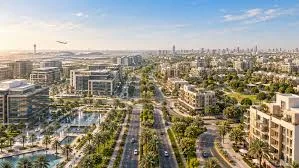
Dubai Land Residence Complex (DLRC), located in Wadi Al Safa 5, has attracted considerable attention from developers and property investors. Several residential projects have entered the market, with studios and apartments starting from approximately AED 495,000.
The location offers relatively affordable entry prices, road connectivity and access to employment and education hubs such as Dubai Silicon Oasis and Academic City. The planned Dubai Metro Blue Line is another infrastructure development that could support its long-term residential appeal.
However, there is another side to the market.
Several developers are launching similar apartment projects, with a large number of studios and 1-bedroom units expected to reach completion between 2027 and 2029. This could increase competition among landlords and property sellers.
So, is DLRC a good location for property investment in 2026?
My assessment is that DLRC has a reasonable long-term investment case, particularly for buyers seeking affordable residential properties. However, the investment outcome will depend heavily on the purchase price, apartment specifications, developer reliability and the supply entering the market over the next three years.
Let’s examine the factors that support its potential and the risks investors should consider.
1. Access to employment and education hubs supports rental demand
One of DLRC’s main advantages is its proximity to established employment and education destinations.
Dubai Silicon Oasis is an established residential and business district with technology companies, offices, retail facilities and residential communities. Academic City is another important demand centre, with universities and educational institutions attracting students, faculty and professionals.
This creates several potential tenant segments for DLRC:
- Professionals working in Dubai Silicon Oasis.
- Students and academic staff associated with Academic City.
- Young couples looking for relatively affordable apartments.
- Small families seeking residential properties outside expensive central locations.
For investors, this proximity provides a potential rental demand base.
However, being close to an employment hub does not automatically guarantee high occupancy. Tenants also consider travel time, public transport, apartment condition, building facilities and monthly rental costs.
A competitively priced studio or 1-bedroom apartment with a practical layout may attract more interest than an expensive unit offering facilities that tenants rarely use.
2. Road connectivity supports residential convenience
DLRC benefits from access to two important road networks: Sheikh Mohammed Bin Zayed Road and Al Ain Road.
These connections provide access to different parts of Dubai, including Dubai Silicon Oasis, Academic City and other residential and commercial districts.
This is particularly relevant for residents who own cars and commute to work.
Road connectivity also supports the location’s appeal among tenants who prefer relatively affordable accommodation while maintaining access to employment centres.
However, investors should examine the location of the actual building rather than relying on the community’s general road connectivity.
Distance to major roads, entry and exit points, peak-hour traffic and travel times can vary between projects.
Investment implication: Good Road access supports residential convenience, but the rental advantage will depend on the building’s actual location and the tenant’s daily commute.
3. Dubai Metro Blue Line could support future demand
The Dubai Metro Blue Line is an important infrastructure development to watch when assessing DLRC’s long-term potential.
The planned network includes stations serving areas around Dubai Silicon Oasis and Academic City. Improved public transport connectivity could make nearby residential locations more attractive to people who prefer travelling without a private vehicle.
This could broaden the potential tenant base for DLRC.
However, investors should be careful about assuming that every property in the community will receive the same benefit.
The actual advantage will depend on:
- Distance between the building and the nearest station.
- Availability of pedestrian access.
- Feeder bus and other transport connections.
- Travel time to employment and education destinations.
There is also a difference between an announced infrastructure project and an operational metro connection.
Investment implication: The Blue Line provides a potential long-term demand catalyst, but investors should not pay a premium today based solely on future metro connectivity.
4. Affordable entry prices provide access to a wider investor segment
Affordability is one of DLRC’s strongest selling points.
Based on the projects discussed, advertised starting prices generally range from AED 495,000 to AED 700,000 for studios, although actual prices depend on unit size, floor, specifications and availability.
This gives investors an opportunity to enter Dubai’s residential market without committing the capital required for properties in more established locations.
For example:
- KHK 31 Residences has reported starting prices of AED 495,000–530,000.
- Celesto Phase 2 starts at approximately AED 540,000–580,000.
- Cove Living Residence has reported starting prices around AED 580,000.
- Veona by Gutti starts at approximately AED 630,000.
Lower entry prices can be useful for first-time investors and overseas buyers.
But affordability alone does not establish investment value.
Investors should calculate the price per square foot, expected annual rent, service charges and total acquisition costs.
A studio purchased for AED 550,000 may appear attractive. However, if its size is very small or its price per square foot is significantly higher than comparable ready properties, the investment may not offer the expected value.
Investment implication: DLRC’s entry prices are attractive, but investors should focus on the relationship between purchase price and achievable rental income rather than the advertised starting price.
5. New residential developments offer modern facilities, but also increase competition
DLRC has attracted several developers, including Imtiaz, Wadan, Tarrad, Zoya, Object 1 and other residential development companies.
Many projects offer facilities such as:
- Swimming pools and rooftop recreation areas.
- Gyms and wellness facilities.
- Children’s play areas.
- Landscaped gardens.
- Smart-home features.
- Furnished apartments.
- Shared entertainment spaces.
These features can support tenant interest, particularly among young professionals and small families.
However, there is a growing similarity between the projects.
Many developers are targeting the same buyer segment with studios and 1-bedroom apartments. As a result, tenants may have several comparable buildings to choose from when these developments are completed.
This could make apartment quality, layout, rent and service charges more important than the number of facilities advertised.
Investment implication: Modern amenities support the residential proposition, but they are not a guarantee of rental growth or capital appreciation.
6. Growing apartment supply is the biggest investment concern
The most important factor investors should monitor is the volume of new residential supply expected between 2027 and 2029.
Several projects discussed in this guide have handover targets within this period.
The concentration of new launches creates a potential supply challenge, particularly in the studio and 1-bedroom segments.
Consider what could happen when multiple developments are completed around the same time.
A large number of investors may begin advertising their apartments for rent. At the same time, some owners may decide to sell their completed units and recover their capital.
This could create competition in two markets:
Rental market: Landlords may need to offer competitive rents, furnished packages or other incentives to secure tenants.
Resale market: Investors looking to exit may compete with other owners selling similar apartments, potentially putting pressure on resale prices.
The actual impact will depend on population growth, employment creation, household formation and the pace at which new residents move into DLRC and surrounding communities.
Therefore, the number of new apartments should always be assessed against the likely growth in tenant demand.
For investors, three precautions are particularly important:
- Avoid paying a significant premium for standard studio apartments.
- Give preference to practical layouts and competitive prices per square foot.
- Compare competing project handovers before committing to developments scheduled for 2028–2029.
It is also worth comparing the total cost of an off-plan apartment with the current price of a similar ready property in DLRC.
This helps establish whether the new launch offers genuine value or whether its price already reflects expected future growth.
7. Which type of property could perform better in DLRC?
Not all apartments will face the same level of competition.
Studios have a lower entry price and may appeal to students and single professionals. However, they are also a common product across several new developments.
One-bedroom apartments could attract professionals and couples who need additional living space.
Two-bedroom apartments may appeal to small families, particularly if the building offers practical layouts, parking and family facilities.
Investors should compare the purchase price and expected rent across these categories rather than assuming that smaller apartments will always produce better yields.
The important consideration is the relationship between supply and tenant demand within each apartment segment.
For example, if several new buildings introduce hundreds of similar studios, a well-designed 1-bedroom apartment at a competitive price could offer a stronger rental proposition.
This is a possibility to investigate through actual rental transactions, not a guaranteed outcome.
What is the biggest risk for DLRC investors between 2027 and 2029?
The biggest risk is a mismatch between new apartment supply and actual rental demand.
DLRC has attracted developers with similar residential concepts and overlapping target audiences.
A significant proportion of the new inventory consists of studios and 1-bedroom apartments. If several projects are handed over within a short period, landlords could face increased competition.
This does not necessarily mean that property prices or rents will fall. Demand could grow alongside supply.
However, investors should not assume that every newly completed apartment will immediately generate the rental income advertised during its launch.
The following factors will determine how the market performs:
Population growth: More residents moving into DLRC and surrounding areas could support rental absorption.
Employment growth: Expansion around Dubai Silicon Oasis and other nearby business districts could create additional housing demand.
Infrastructure delivery: Better public transport connectivity could improve accessibility.
Competitive pricing: Developers and landlords offering better value may attract tenants more quickly.
Construction and handover schedules: Delays or concentrated completions could change the timing of available inventory.
My recommendation is to assess the actual number of competing apartments, not just the number of announced projects.
An investor purchasing in 2026 should consider what the rental market could look like when the apartment is ready for occupation in 2028 or 2029.
Final verdict: Should you invest in DLRC in 2026?
DLRC offers a reasonable investment proposition for buyers seeking affordable residential properties in Dubai.
Its proximity to Dubai Silicon Oasis and Academic City, road connectivity, relatively accessible purchase prices and potential future transport improvements provide a foundation for residential demand.
However, the growing supply of new apartments is a significant consideration.
Among the projects discussed in this guide:
- KHK 31 Residences stands out for its relatively low advertised entry price and targeted Q1 2027 handover.
- Celesto Phase 2 offers another lower-budget option, although investors should carefully assess its compact studio sizes.
- Cove Living Residence offers an earlier expected handover and a broad apartment mix, but its large inventory deserves attention.
- Veona by Gutti has a relatively small development inventory and a wider choice of apartment configurations.
- The Archive and Kore offer distinctive residential concepts, while Weston Phase 2 and 1CTRL provide technology-focused facilities and larger apartment options.
- Treppan Vision and Elvora by Zoya provide additional choices for buyers considering later handover periods.
I would not select a project simply because it has the lowest advertised starting price or the longest list of amenities.
The investment decision should come down to four questions:
- Are you buying at a competitive price per square foot?
- Does the developer have a credible delivery record?
- Can the apartment generate realistic rental income after ownership expenses?
- Will the property remain competitive when other projects are handed over?
My overall view is that DLRC deserves consideration as an affordable residential investment location in 2026, but project selection and purchase price will be critical.
The location’s long-term performance will depend on how effectively population growth, rental demand and infrastructure development absorb the new apartment supply.
For investors, buying a well-priced apartment with practical specifications is likely to be a more sensible approach than paying a premium for a new launch based on future expectations.
Frequently Asked Questions
1. What is the starting price of new projects in DLRC in 2026?
Based on the 10 projects covered in this guide, advertised starting prices range from approximately AED 495,000 for KHK 31 Residences to AED 945,000 for a 1-bedroom apartment at 1CTRL. Actual prices vary by unit size, floor, view and availability.
2. Is Dubai Land Residence Complex a freehold area?
DLRC offers freehold residential ownership. Buyers should verify the specific property’s title, project registration and ownership eligibility through the Dubai Land Department before purchasing.
3. Which DLRC projects have an expected handover in 2027?
KHK 31 Residences is targeting Q1 2027, Cove Living Residence Q1–Q2 2027, and Veona by Gutti Q4 2027. These dates should be checked against the contractual handover schedules.
4. Which DLRC projects are expected to be handed over in 2028?
Celesto Phase 2 is targeting Q2 2028, The Archive Q3 2028, Kore Q4 2028 and Weston Phase 2 Q4 2028. Elvora by Zoya has reported handover expectations extending into late 2028 or early 2029.
5. Is DLRC suitable for rental investment?
DLRC has potential rental demand because of its proximity to Dubai Silicon Oasis and Academic City. Its relatively affordable apartments may appeal to professionals, students and small families. However, rental returns will depend on purchase price, apartment quality, service charges and competing supply.
6. Will the Dubai Metro Blue Line benefit DLRC?
The planned Blue Line includes stations serving areas around Dubai Silicon Oasis and Academic City. Better transport connectivity could support demand in nearby residential communities. However, the benefit to individual DLRC buildings will depend on their actual distance from the stations and available transport connections.
7. What is the average studio price in DLRC?
The advertised studio starting prices across the selected projects generally fall between approximately AED 495,000 and AED 700,000. These are entry prices rather than verified community-wide averages.
8. What is the main risk of buying an off-plan property in DLRC?
The main concern is competing apartment supply, particularly studios and 1-bedroom units scheduled for completion between 2027 and 2029. If tenant demand does not grow at a similar pace, rental prices, occupancy and resale values could face pressure.
9. Is DLRC better for short-term or long-term property investment?
DLRC (Dubai Land Residence Complex) is better assessed as a medium-to-long-term residential investment rather than a location where investors should automatically expect quick capital appreciation. Its performance will depend on rental absorption, infrastructure improvements and the delivery of new developments.
Disclaimer: Prices, payment plans, unit availability and handover dates are indicative and subject to change. Verify project registration, construction progress, contractual completion dates and ownership documentation with the relevant authorities and developer before purchasing.



Leave a Reply