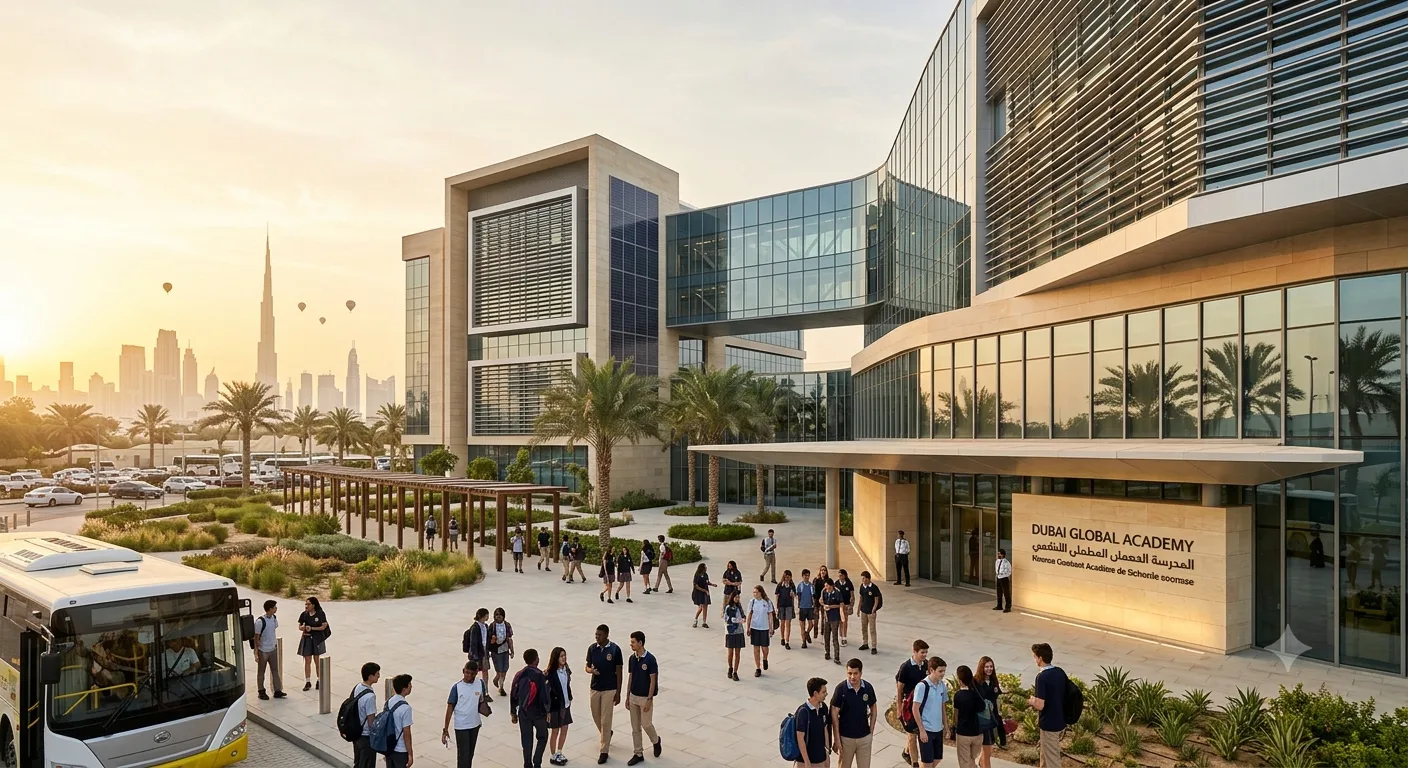
Dubai is adding 26 new private education institutions during the 2026–27 academic year. That includes seven schools, 17 early childhood centres and two international higher education institutions.
At first glance, this looks like an education story. But there is a bigger point for anyone watching Dubai’s population, residential demand and property market.
Schools tend to follow families.
When new schools and nurseries open in growing communities, they can make those areas more practical for residents. For property investors, that makes education infrastructure worth tracking alongside roads, retail, healthcare and public transport.
The latest figures from Dubai’s Knowledge and Human Development Authority (KHDA) show that private education is continuing to expand across several age groups. The sector recorded 4.6% annual growth across early childhood, schools and higher education over the past three academic years.
Dubai will add nearly 17,000 new school places
The biggest part of the expansion is at school level.
Seven new private schools will add 16,846 places during the 2026–27 academic year. Four will follow the UK curriculum, while three will offer the International Baccalaureate.
The new campuses include Harrow International School Dubai, Queen Elizabeth’s School Dubai Sports City and Rugby School Dubai.
This matters because Dubai’s private school market has already been expanding. Over the past three years, 21 new private schools have opened, while private-school enrolment increased by 3.1%.
The numbers tell an important story.
Dubai is not simply adding a few schools to existing neighbourhoods. Education providers are adding capacity as the city continues to attract families and new residents.
For parents, this means more choice.
For developers, it means education is becoming an important part of community planning.
For property buyers, it gives you another number to track before buying in a new residential area.
Early childhood education is expanding even faster in terms of new centres
Dubai will also get 17 new private early childhood centres, adding more than 1,700 places.
The centres will offer different programmes, including the UK’s Early Years Foundation Stage, Montessori, Ontario, French and Indian curricula.
This is particularly relevant for families with young children.
A nursery or early learning centre close to home can reduce daily travel time. That can influence where families choose to rent or buy.
The growth has been consistent. Dubai added 87 early childhood centres over the last three years, while enrolment increased by 2.6% during that period.
So if you are looking at a residential community aimed at young families, do not check only the number of schools.
Check nurseries too.
A community with early-years facilities can become much more useful to families with children below school age.
The higher education market is also getting stronger
The expansion does not stop at schools.
Two international higher education institutions are joining Dubai’s education market.
The American University of Beirut’s Dubai campus is scheduled to open in September 2026. Peking University HSBC Business School is expected to launch MBA and EMBA programmes in January 2027.
This follows a much larger increase in higher education over recent years.
Dubai added 11 higher education institutions during the past three years, while enrolment increased by 29%.
That is a significant number.
It also shows that Dubai’s education demand is not limited to primary and secondary schools. The city is building capacity across the full education market.
That can support demand for apartments near education clusters, particularly from students, academics, young professionals and families working in education-related sectors.
Why Dubai’s residential property market
This is where the education data becomes useful for property investors.
A new school does not automatically mean property prices will rise.
That would be too simplistic.
But schools can improve the practical appeal of a residential location.
Think about the decision from a parent’s point of view.
If you have two similar communities with comparable apartments or townhouses, but one has a good school nearby, several nurseries, retail and parks, that community may be easier for your family to live in.
The same logic applies to renters.
A family looking for a three-bedroom townhouse may care about the commute to school as much as the distance to Downtown Dubai.
This can affect rental demand and tenant retention.
It can also influence resale demand because the future buyer may have similar requirements.
New schools can be an early signal for developing communities
There is another useful point for investors.
Education infrastructure can provide clues about where residential populations are growing.
Developers and education operators need enough potential students to justify a new campus.
So when a recognised school opens in or close to a developing residential area, it is worth asking:
- How many homes are being delivered nearby?
- Who are those homes being built for?
- How many families are expected to live there?
- What other schools already operate in the area?
- How far will residents need to travel?
- Are nurseries available?
- Is the school capacity sufficient for the expected population?
- Are roads and public transport keeping pace with development?
These questions give you a better view of the community than simply looking at a project’s launch price.
Education capacity can support family-oriented communities
Dubai has several large residential areas where schools are an important part of the investment story.
For example, areas with villas and townhouses often depend heavily on family demand. In such locations, schools can become part of the reason tenants choose one community over another.
This is particularly relevant for newer master-planned communities.
A new community may initially have limited retail, healthcare and education options. As more residents move in, these services tend to become increasingly important.
Education is especially important because families often want to minimise the daily school commute.
That creates a simple property-market relationship:
More families → more education demand → more school capacity → greater convenience for residents.
The relationship is not automatic, but it is useful when assessing long-term residential demand.
Dubai’s teacher workforce is growing too
There is another figure that should not be ignored.
The number of teachers working in Dubai’s private education sector increased by 17.5% over the past three academic years. (KHDA)
This is a sign that the expansion is creating demand for education professionals as well as student places.
That can have a secondary effect on housing.
Teachers and other education workers need homes. International schools also attract employees from outside the UAE.
Some may rent apartments close to their workplace. Others may eventually buy property after establishing themselves in Dubai.
The effect is unlikely to be large enough to move the entire property market by itself.
But in specific education-heavy locations, it can contribute to rental demand.
What 26 new institutions tell us about Dubai’s population growth
The most important message is not the number 26 on its own.
It is the continued investment behind the number.
Dubai’s private education sector recorded 4.6% annual growth over the past three academic years. At the same time:
- Private-school enrolment rose 3.1%
- Early childhood enrolment rose 2.6%
- Higher education enrolment rose 29%
- Teacher numbers increased 17.5%
- 21 private schools were added over three years
- 87 early childhood centres were added over three years
- 11 higher education institutions were added over three years
Taken together, these figures point to sustained demand for education services.
They also fit into Dubai’s wider Education 33 Strategy, which aims to increase education choice, attract international institutions and strengthen the emirate’s education system.
The bigger investment lesson
Dubai’s latest education expansion gives property buyers another useful way to assess residential communities.
Do not treat a new school as a guarantee of price appreciation.
Instead, use it as one piece of the demand analysis.
Look at schools alongside population growth, completed housing, future supply, rents, employment centres, roads, retail and healthcare.
The strongest residential locations usually have several of these factors working together.
The 2026–27 education expansion is also worth watching because it adds substantial capacity at different levels. The seven new schools alone will bring 16,846 places, while 17 early childhood centres add another 1,700-plus places.
That is a meaningful increase in education capacity.
For families, it means more choices.
For developers, it shows where demand is building.
For investors, it is another data point that can help separate a community with genuine long-term demand from one that simply has a large number of new properties coming to market.
The practical takeaway: when you compare Dubai communities, ask not only “What is the property price?” Ask “Who will live here, where will their children study, and how easy will daily life be?”
That question can give you a much better understanding of the rental and resale market than the launch price alone.
 Amoli
Amoli
 Vaishali M