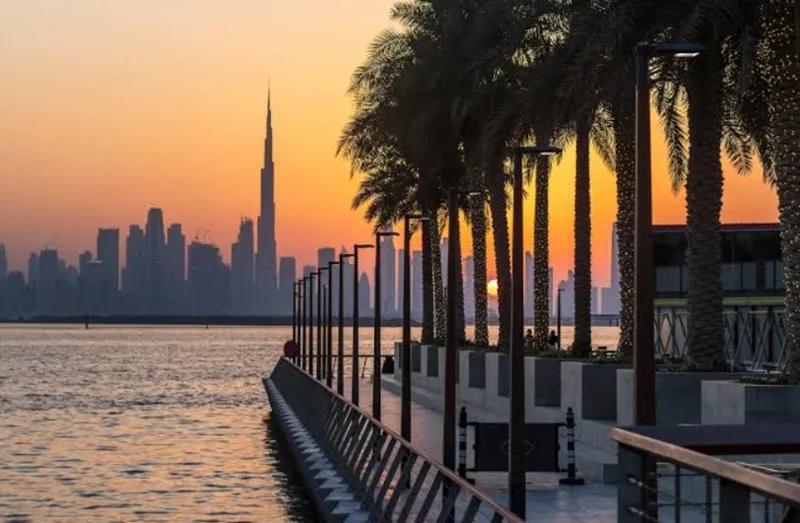
Dubai Creek Harbour is no longer just a future waterfront project. In 2026, it is becoming a large mixed-use district with homes, hotels, retail, parks, offices, a marina and new transport links.
The question is whether it can become Dubai’s next Downtown.
The comparison makes sense, but Creek Harbour still has a long way to go. Downtown Dubai is an established city centre with Burj Khalifa, Dubai Mall, Dubai Opera, hotels, offices and a large visitor base. Creek Harbour is still being built.
Its future scale, however, is significant. The master plan covers 6 square kilometres, with plans for more than 200,000 residents. It includes about 7.4 million sq m of residential space, 500,000 sq m of parks and open areas, Dubai Square, hotels, retail, commercial space and the future Dubai Creek Tower.
The Dubai Metro Blue Line is another major change. The 30 km line will include 14 stations, with a dedicated station at Dubai Creek Harbour. The line is targeted to open on 9 September 2029.
So, is Dubai Creek Harbour really becoming the next Downtown?
It has the scale and infrastructure plan to become a major urban centre, but it is too early to call it a replacement for Downtown Dubai. For property investors, the gap between today’s community and its planned future is the main opportunity and also the main risk.
Dubai Creek Harbour Details!
| Factor | Dubai Creek Harbour |
|---|---|
| Master plan size | 6 sq km |
| Planned population | 200,000+ |
| Residential space | About 7.4 million sq m |
| Parks and open areas | About 500,000 sq m |
| Dubai Square | 2.6 million sq m district |
| Dubai Square retail space | About 750,000 sq m |
| Planned hotels | 24 |
| Planned hotel rooms | About 5,800 |
| Dubai Metro Blue Line | 30 km |
| Blue Line stations | 14 |
| Blue Line opening target | September 2029 |
| Recent average sale price | About AED 2.56M per transaction |
| Recent average price | About AED 2,558 per sq ft |
| Example apartment ROI | Roughly 5%–6% in established buildings |
1. Why the 6 Sq Km Master Plan Matters
Size alone does not make a successful property market. What matters is what is built on that land.
Dubai Creek Harbour is planned as a mixed-use urban district rather than only a residential community.
Emaar’s current information lists around 7.4 million sq m of residential space and 500,000 sq m of parks and open areas. The wider master plan also includes retail, offices, hotels, restaurants, entertainment and waterfront areas.
Earlier master-plan information also set out around 300,000 sq m of commercial space, 24 hotels and about 5,800 hotel rooms, along with a large retail area.
This mix is important.
A residential area depends heavily on other parts of the city for jobs, shopping and entertainment. A mixed-use district can create more demand inside the community itself.
That is the model Dubai Creek Harbour is trying to build.
It aims to have:
- Homes
- Offices
- Hotels
- Retail
- Restaurants
- Parks
- Marina facilities
- Entertainment
- Public transport
- Waterfront promenades
This is one reason the project is being positioned as a future urban centre rather than simply another Dubai residential area.
2. Dubai Square Could Be the Biggest Change
Dubai Square is one of the strongest parts of the Creek Harbour plan.
The wider Dubai Square district is planned at around 2.6 million sq m, with about 750,000 sq m of gross retail space. It is designed to combine retail, dining, entertainment and technology rather than operate only as a traditional shopping mall.
Emaar’s 2024 announcement said Dubai Square would be directly linked with Dubai Creek Tower. Emaar has also said the project will use smart technology and AI in its retail design.
In 2026, Emaar says construction of Dubai Square is underway and is expected to take about three years.
That makes Dubai Square an important medium-term catalyst.
The effect on property could come from several directions.
More retail can mean:
- More visitors.
- More jobs.
- More restaurants and services.
- More demand for nearby homes.
- Better daily convenience for residents.
- Stronger appeal to tourists and short-term renters.
But investors should not assume that a large mall automatically means higher property prices.
The real test will be tenant demand, visitor numbers, opening dates and the quality of the final retail mix.
3. What About Dubai Creek Tower?
Dubai Creek Tower is designed to be the visual landmark of the district.
It was designed by Santiago Calatrava and was originally planned as a very tall observation tower. The project was delayed, and its final height and design have been subject to changes.
That makes the tower an important point for investors.
It is better to treat Dubai Creek Tower as a future catalyst rather than a completed asset.
Emaar’s current Creek Harbour material continues to position the tower as an iconic part of the community.
The tower matters because landmarks can help create a clear identity for a district.
Downtown has Burj Khalifa.
Dubai Marina has its skyline and waterfront.
Palm Jumeirah has its island shape and Atlantis.
Dubai Creek Harbour needs its own identity.
Dubai Creek Tower, together with Dubai Square and the waterfront, could provide that identity.
However, investors should avoid putting a fixed financial value on the tower until its construction schedule and final form are clear.
4. The Metro Blue Line Could Change Connectivity
Transport is one of the strongest reasons to take Dubai Creek Harbour seriously.
The Dubai Metro Blue Line is 30 km long and has 14 stations. It will connect Dubai Creek Harbour with areas including Dubai Festival City, Ras Al Khor, International City, Dubai Silicon Oasis and Academic City.
The line will also connect with the existing Red and Green lines.
The RTA expects the Blue Line to open on 9 September 2029. As of the latest RTA project update, construction had reached 10%, with completion expected to reach 30% by the end of 2026.
The project has an estimated investment of more than AED 20.5 billion. RTA expects the line to serve around 200,000 daily users in 2030, rising to about 320,000 by 2040.
For Creek Harbour, this is important.
The area already has road access and is about 10 minutes from Downtown Dubai and Dubai International Airport under normal driving conditions, according to Emaar.
The metro will add another option.
For investors, transport can improve:
- Tenant demand
- Employee access
- Visitor access
- Resale appeal
- Long-term liquidity
But the key date is 2029. Investors buying in 2026 should understand that the full transport benefit is still several years away.
5. Hotels, Offices, Parks and Retail Create a Real City
A major difference between Creek Harbour and a normal apartment district is the planned mix of uses.
The master plan includes 24 hotels, around 5,800 rooms, commercial space, large parks and retail areas.
Emaar’s current website lists 500,000 sq m of parks and open spaces and 7.4 million sq m of residential space.
The waterfront also has an existing marina and promenade.
There are already completed and operating residential buildings in the area. Emaar’s portfolio includes communities and buildings such as Creek Edge, Harbour Views, Palace Residences and other waterfront projects.
This is important because Creek Harbour is not starting from zero in 2026.
There are already residents, completed buildings and rental transactions.
The next stage is about adding enough retail, transport, offices, hotels and public spaces to turn the community into a self-contained urban centre.
6. What Are Property Prices in Dubai Creek Harbour in 2026?
Current transaction data shows that Dubai Creek Harbour already has a real sales market.
Bayut’s DLD-linked transaction data for the last 12 months shows an average transaction price of about AED 2.895 million and an average price of around AED 2,558 per sq ft.
Another current market source puts the average resale apartment price in H1 2026 at around AED 2,399 per sq ft. The difference shows why investors should compare actual transactions, not rely on one headline price.
Prices also vary widely by building.
A basic apartment without a strong view can trade very differently from a high-floor unit facing the Creek, Downtown skyline or Ras Al Khor Wildlife Sanctuary.
Recent transactions recorded by Property Finder also show a wide range of prices. Examples in August 2026 include:
- A 2-bedroom Silva Tower unit at about AED 2.88 million
- A 2-bedroom Creek Haven unit at about AED 3.41 million
- A 2-bedroom Creek Bay Tower A unit at about AED 4.90 million
These are individual transactions, not an area average.
For buyers, this means price per sq ft and view matter more than the community average.
7. Rental Yields: Does Creek Harbour Already Produce Income?
Yes.
This is another difference between Creek Harbour and a purely future project.
Completed buildings already have rental markets.
Bayut data shows several established buildings in Dubai Creek Harbour producing gross ROI in the roughly 5%–6% range for apartments, depending on the building and unit type.
For example, Bayut reports:
- Dubai Creek Residence: up to 5.72% for 1-bedroom units
- Harbour Views: up to 5.45% for 1-bedroom units
- Creek Edge: about 5.33% for 1-bedroom units
- Harbour Gate: about 6.03% for 1-bedroom units
These are building-level ROI figures, not a guaranteed yield for every property.
For investors, a 5%–6% gross yield is a useful current benchmark for established apartments in the community.
Future buildings may produce different results because their purchase prices, service charges, layouts and rents can vary.
8. Supply and Demand: Is There Too Much Property Coming?
This is one of the main risks.
Dubai Creek Harbour has a large amount of planned residential space. That means future supply will remain high.
The master plan includes around 7.4 million sq m of residential space.
More supply can be positive if population and jobs grow at the same time.
It becomes a problem if new units arrive faster than residents and tenants can absorb them.
This is why the planned population of more than 200,000 people matters. If the district gets close to its planned population over time, the large housing supply will have a much stronger demand base.
The current market also shows that demand is not uniform across Dubai.
Dubai’s wider residential market became more selective during 2026. Chestertons reported that residential activity had slowed, while buyers were becoming more careful.
That makes property selection more important.
In Creek Harbour, the strongest units are likely to be those with:
- Creek views
- Downtown skyline views
- High floors
- Waterfront positions
- Good layouts
- Strong amenities
- Walkable access to retail and public spaces
Investors should not assume that every building will perform equally.
9. Dubai Creek Harbour vs Downtown Dubai
The comparison with Downtown needs some context.
Downtown Dubai is already established.
It has Burj Khalifa, Dubai Mall, Dubai Opera, hotels, offices and a mature tourist economy. Emaar reported that Dubai Mall attracted 105 million visitors in 2023.
Dubai Creek Harbour does not yet have that level of visitor activity.
But it has something Downtown does not have in the same way: a large amount of future development land and a new master plan being built around a waterfront district.
The two areas therefore serve different purposes.
| Factor | Dubai Creek Harbour | Downtown Dubai |
| Status in 2026 | Growing master development | Established city centre |
| Size | 6 sq km | Smaller, established core |
| Waterfront | Yes | Limited |
| Major landmark | Dubai Creek Tower planned | Burj Khalifa |
| Major retail | Dubai Square planned | Dubai Mall |
| Metro | Blue Line station planned | Existing Metro |
| Population | 200,000+ planned | Established population |
| Investment stage | Growth phase | Mature phase |
| Main opportunity | Future growth | Established demand |
| Main risk | Development and supply | Higher entry price |
The key point is this:
Creek Harbour does not need to replace Downtown to be a successful investment.
It can become a major Dubai centre in its own right.
10. 2–5 Year Investment Potential
The next two to five years are likely to be important.
Several major catalysts fall inside this period:
2026–2027
More residential projects and supporting infrastructure should continue to come online.
Around 2028
Dubai Square is expected to move closer to completion based on Emaar’s current construction timeline.
2029
The Metro Blue Line is targeted to open on 9 September 2029.
These projects can improve the area’s usefulness and visibility.
A simple investment model helps show the possible effect.
If an apartment bought for AED 3 million increases by:
- 5% per year, it could reach about AED 3.47M after 3 years and AED 3.83M after 5 years.
- 8% per year, it could reach about AED 3.78M after 3 years and AED 4.41M after 5 years.
- 10% per year, it could reach about AED 3.99M after 3 years and AED 4.83M after 5 years.
These are scenarios, not forecasts.
The investment case is strongest if buyers enter before major infrastructure is complete and the area continues to gain residents.
But buying at a high price can reduce future returns. Investors should focus on the entry price rather than simply buying because a large project is planned.
11. Key Risks in 2026
Dubai Creek Harbour has clear upside, but there are five major risks.
1. Future supply
Large amounts of residential space are planned. More supply can limit rent and resale growth.
2. Construction delays
The value of the district depends on several large projects being completed.
3. Dubai Creek Tower uncertainty
The tower is a major part of the area’s identity, but investors should not treat its final delivery as guaranteed until a firm schedule is confirmed.
4. Market correction
Dubai property prices have risen strongly in recent years. The wider market is now more selective, and some reports show lower transaction activity during 2026.
5. High expectations
Creek Harbour is often marketed as the “new Downtown.”
That creates a risk of unrealistic expectations.
The area does not need to become another Downtown to perform well. Investors should judge each property on its own price, rent, location, view and supply.
12. So, Is Dubai Creek Harbour Really Dubai’s Next Downtown?
Not yet.
Downtown Dubai has a mature ecosystem that took years to build. It has proven tourist demand, major landmarks, established retail, offices, hotels and public transport.
Dubai Creek Harbour is still in the growth stage.
But the project has many of the features needed to become a major urban centre:
- 6 sq km of land
- 200,000+ planned residents
- 7.4 million sq m of residential space
- 500,000 sq m of parks and open areas
- A 2.6 million sq m Dubai Square district
- About 750,000 sq m of retail space
- 24 planned hotels
- Around 5,800 hotel rooms
- A 30 km Metro Blue Line
- A dedicated Creek Harbour Metro station
- A major waterfront and marina
- Dubai Creek Tower as a planned landmark
The numbers support the idea that Creek Harbour can become much more than a residential community.
Final Verdict
Dubai Creek Harbour is one of Dubai’s strongest long-term urban growth stories in 2026, but calling it the next Downtown today would be premature.
For investors, the attraction is clear: the community already has completed homes and rental demand, while major catalysts such as Dubai Square and the Metro Blue Line are still ahead.
Current transaction data around AED 2,558 per sq ft and apartment ROI figures of roughly 5%–6% give investors a real market base rather than a purely future story.
The 2–5 year case depends on execution.
If Dubai Square is delivered, the Blue Line opens as planned, more residents move in and the district gains offices, hotels, retail and entertainment, Creek Harbour could become one of Dubai’s most important mixed-use centres.
But investors should not buy every Creek Harbour property at any price.
The best strategy in 2026 is selective buying.
Focus on a good building, a strong view, sensible price per sq ft, proven rental demand and access to future amenities.
The most accurate way to describe Dubai Creek Harbour today is not “Dubai’s next Downtown.”
It is “a developing waterfront urban centre that has the scale and infrastructure plan to become one of Dubai’s next major city hubs.”
That distinction matters.
Downtown Dubai is already proven.
Dubai Creek Harbour is where investors are betting on what comes next.
 Amoli
Amoli